Liftable Gooseneck vs. Fixed: Which Lowbed Trailer Cuts Loading Time by 40%?
April 21, 2026
Comparing liftable gooseneck and fixed gooseneck lowbed trailers. Discover how a liftable gooseneck design can reduce loading time by up to 40% and boost your heavy haul efficiency.
Introduction: Time Is Money on Every Job Site
Every minute your lowbed trailer spends loading heavy machinery is a minute it is not earning revenue. When you transport excavators, bulldozers, or mining trucks, the loading process often becomes a bottleneck. The choice between a liftable gooseneck and a fixed gooseneck lowbed trailer directly affects your cycle time. Many operators report that a liftable gooseneck cuts loading time by as much as 40%. But how does it work, and is it worth the investment?
This article compares both designs, explains the time-saving mechanism, and helps you decide which lowbed trailer fits your heavy haul operations.
What Is a Fixed Gooseneck Lowbed Trailer?
A fixed gooseneck lowbed trailer has a rigid, non-removable gooseneck section at the front. The trailer deck sits lower than a standard flatbed, but the gooseneck remains permanently attached. To load heavy equipment, you must use ramps at the rear. The machine drives up the ramps onto the deck. This process requires careful alignment and often takes multiple attempts, especially for tracked vehicles like excavators or bulldozers.
- Pros of Fixed Gooseneck:
– Lower initial cost
– Simpler construction – fewer moving parts
– Reliable for predictable, low-frequency loading
- Cons of Fixed Gooseneck:
– Requires separate ramps
– Steep approach angle for low-clearance machinery
– Longer loading time – typically 15–25 minutes per machine
– Higher risk of ramp slippage or misalignment
What Is a Liftable Gooseneck Lowbed Trailer?
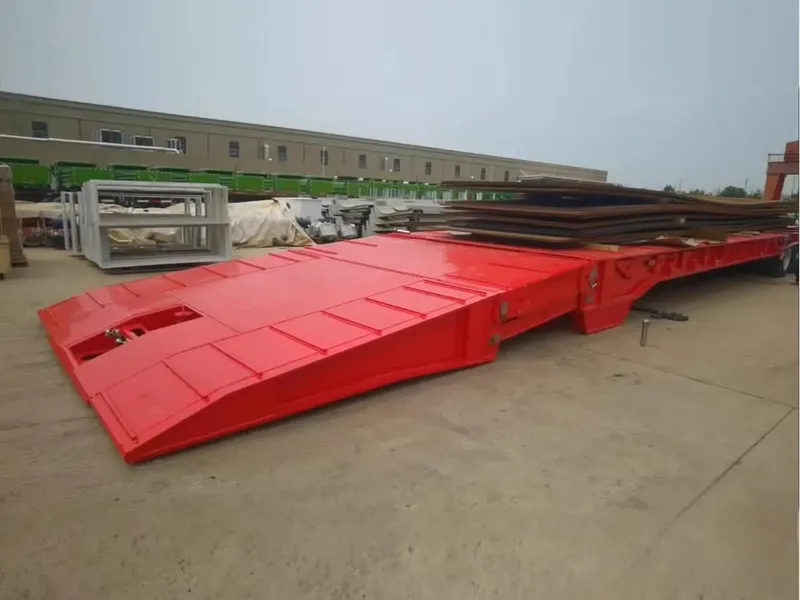
A liftable gooseneck lowbed trailer (also called a detachable or hydraulic gooseneck) allows the front gooseneck to rise hydraulically or mechanically. When lifted, the gooseneck separates from the deck, creating a drive-on ramp at the front. The trailer deck lowers to ground level, or near-ground level, so equipment can drive straight on without steep ramps.

- Pros of Liftable Gooseneck:
– Ground-level loading – no steep ramps needed
– Much faster loading – often under 10 minutes per machine
– Safer for operators and equipment
– Ideal for low-clearance or tracked vehicles
- Cons of Liftable Gooseneck:
– Higher purchase price
– More complex hydraulic system (requires maintenance)
– Heavier than fixed gooseneck designs (slightly reduced payload)
How Does the Liftable Gooseneck Cut Loading Time by 40%?
Let’s break down the time savings with real-world examples.
- Fixed Gooseneck Loading Process (Typical)
1. Position trailer and lower rear ramps – 3 minutes
2. Align equipment with ramps – 2 minutes
3. Drive equipment up ramps – 2 minutes
4. Adjust position on deck – 2 minutes
5. Secure equipment with chains – 5 minutes
6. Remove and store ramps – 3 minutes
Total time per load: approximately 17 minutes
- Liftable Gooseneck Loading Process (Typical)
1. Position trailer and activate hydraulic lift – 1 minute
2. Gooseneck rises and deck lowers to ground – 1 minute
3. Drive equipment straight onto deck – 1 minute
4. Adjust position (minimal) – 1 minute
5. Secure equipment – 4 minutes
6. Lower gooseneck back into travel position – 1 minute
Total time per load: approximately 9 minutes
That is a reduction of 8 minutes per load – nearly 47%. For fleets loading multiple machines per day, the cumulative time savings translate directly into more trips and higher revenue.

Real-World Impact: One Fleet’s Experience
A mining contractor in Zambia operates five lowbed trailers moving excavators between pits. They switched from fixed to liftable gooseneck trailers. Previously, each load took 20 minutes. After the switch, each load takes 10 minutes. Over a 10-hour shift, each trailer now makes 60% more trips. The contractor recovered the higher purchase cost of the liftable goosenecks within 8 months through increased productivity.
When Should You Choose Fixed Gooseneck?
Fixed gooseneck lowbed trailers still make sense in specific scenarios:
– Infrequent loading – If you load only once per day, the time saving matters less.
– Tight budgets – Lower upfront cost helps new businesses.
– Smaller equipment – For machines under 20 tons, ramp loading is less challenging.
However, for any operation with daily multiple loads or heavy tracked machinery, the liftable gooseneck quickly pays for itself.
Which Lowbed Trailer Cuts Loading Time by 40%?
The answer is clear: the liftable gooseneck lowbed trailer. The ground-level, drive-on design eliminates ramp handling and alignment delays. While the initial investment is higher, the productivity gain often exceeds 40% in cycle time reduction. For contractors, miners, and heavy haulers who value efficiency, the liftable gooseneck is the superior choice.
Conclusion: Match the Trailer to Your Workflow
Ask yourself these three questions before buying:
1. How many loads do you make per day?
2. What type of equipment do you move most often (tracked or wheeled)?
3. Is your priority upfront cost or long-term productivity?
If you load tracked excavators or bulldozers multiple times daily, invest in a liftable gooseneck lowbed trailer. The 40% time saving will transform your operation. If your loads are infrequent and equipment is wheeled, a fixed gooseneck may still serve you well.
At Shandong Global Diamond Automobile Technology Co., Ltd. , we manufacture both configurations. Our engineers help you choose the right lowbed trailer based on your cargo, terrain, and budget. Contact us today for a free consultation and a customized quote.
Ready to cut your loading time by 40%? Ask about our liftable gooseneck lowbed trailers with custom axle configurations and payloads up to 150 tons. Get a quote today.