What Is a Cement Tanker Trailer and How Does Pneumatic Discharge Work?
March 24, 2026
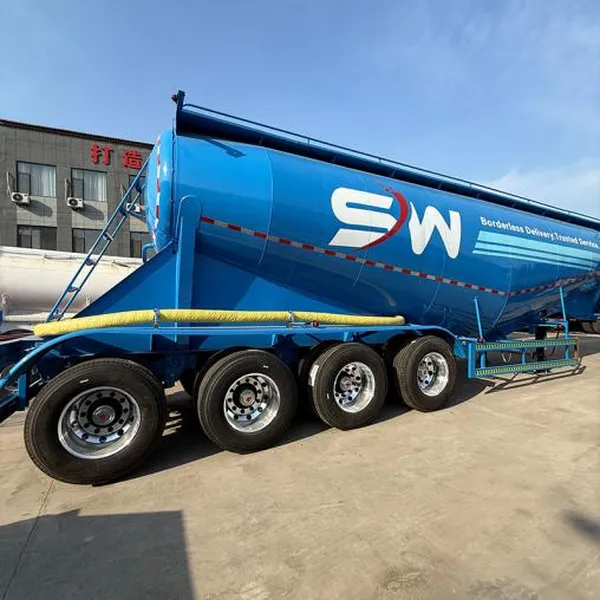
Transporting dry bulk materials like cement, fly ash, and lime requires a specialized solution that protects against moisture while ensuring rapid unloading. The pneumatic Bulk cement tanker is the industry standard for large-scale construction and infrastructure logistics. By using compressed air to “fluidize” dry powders, these trailers eliminate manual labor and dramatically reduce turnaround times.
How Does a Pneumatic Cement Trailer Work?
A pneumatic cement trailer is engineered to transform solid powder into a flowable state through a four-stage process:
- Discharge: The “fluidized” material is pushed through discharge pipes into storage silos at a rate of 1.5 to 2.5 tons per minute.
- Loading: Material is gravity-fed through top-mounted, hermetically sealed manholes.
- Sealing: Precision seals prevent moisture ingress, which is critical as even minor humidity can cause cement to clump and block discharge lines.
- Fluidization: Compressed air (typically at 0.2 to 0.35 MPa) is injected into the tank, mixing with the powder to make it behave like a liquid.

Strategic Applications and Capacities
Pneumatic tankers are versatile workhorses used across multiple sectors to maintain supply chain continuity.
| Industry | Application | Typical Capacity |
| Construction | On-site concrete mixing for high-rise or remote sites. | 35 – 60 m³ |
| Manufacturing | Bulk transfer between cement plants and distribution hubs. | 40 – 70 Tons |
| Infrastructure | Large-scale road, bridge, and dam projects. | 45 – 60 m³ |
| Agriculture | Transporting powdered fertilizers and animal feed. | 30 – 45 m³ |

Comparing Tanker Configurations
1. Tank Geometry: V-Type vs. Horizontal
- V-Type Tankers: Featuring a V-shaped bottom, these are optimized for the most complete discharge. The angled walls ensure gravity assists the pneumatic system, leaving minimal residual material.
- Horizontal Cylindrical: These offer excellent pressure distribution and structural strength at a generally lower price point.
2. Compartment Flexibility
- Single-Compartment: Best for dedicated routes carrying one material type.
- Multi-Compartment: Features internal bulkheads. This allows a single trailer to deliver cement and fly ash simultaneously to a batching plant, reducing the number of required trips.
3. Axle & Load Distribution
- 3-Axle Models: The global standard for highway transport, balancing high volume (35–50 m³) with stability and road-legal weight limits.
- 4-Axle/Multi-Axle: Reserved for heavy industrial or mining use where maximum payloads (up to 70 m³) are required on reinforced haul roads.
Core Advantages of Pneumatic Systems
- Zero Product Loss: The closed-loop system prevents material from escaping into the atmosphere, which is environmentally friendly and financially sound.
- Labor Efficiency: Automated discharge removes the need for manual handling, significantly reducing the risk of workplace injuries.
- Customization: Manufacturers can tailor tank thickness (typically 5-8mm), suspension types (mechanical or air), and discharge angles to meet specific regional requirements.

Selecting a Quality Tanker Trailers Manufacturer
When sourcing from major hubs like Shandong, evaluate cement tanker manufacturer based on these quality benchmarks:
- Advanced Fabrication: Look for facilities using robotic welding and CNC cutting to ensure airtight seams and structural integrity.
- Technical Validation: Top-tier suppliers use Finite Element Analysis (FEA) to stress-test tank designs before production.
- Documentation: Ensure the supplier provides ISO 9001 certification, material traceability, and pressure test logs.
Cement Tanker Trailers Essential Maintenance Protocols
To extend the lifespan of your tanker and ensure safety:
- Valve & Seal Audit: Regularly check discharge valves and manhole seals for wear. A loss of pressure during discharge will significantly slow down unloading times.
- Daily Clean-Out: Ensure no residue remains in the tank. Over time, “cement skin” can build up, reducing volume and increasing the risk of clogs.
- Moisture Control: After cleaning, use high-pressure air to dry the tank completely. Moisture is the primary enemy of pneumatic systems.
Frequently Asked Questions About Cement Tanker Trailers
What is the typical capacity of a cement tanker trailer?
Cement tanker trailer capacity ranges from 20 to 70 cubic meters depending on configuration . Two-axle models typically carry 20-30 cubic meters for regional deliveries. Three-axle trailers handle 35-50 cubic meters for general construction. Four-axle configurations carry 50-70 cubic meters for heavy industrial applications . Local road weight regulations often determine maximum legal capacity in your operating area.
How does pneumatic discharge work in cement tankers?
Compressed air enters the sealed tank through a pneumatic system, fluidizing the dry cement powder so it flows like a liquid . This fluidized material then moves through discharge pipes to storage silos or mixing stations . Most units achieve full unloading in 20-40 minutes depending on volume and system pressure . The process requires no manual labor and minimizes product loss .
What materials can pneumatic tankers transport?
Pneumatic dry bulk trailers handle a wide range of powdered materials including cement, fly ash, lime, flour, gypsum, and various chemical powders . This versatility makes them valuable for companies transporting multiple product types. Construction firms use them for cement and fly ash, while agricultural operations transport fertilizers and feed using the same technology .
What safety features should a cement tanker trailer have?
Essential safety features include pressure relief valves preventing over-pressurization, anti-static systems eliminating dust explosion risks, and leak-proof designs preventing contamination . Emergency shut-off valves allow remote flow control during incidents. The sealed tank design protects workers from hazardous material exposure, while automated operation keeps personnel away from danger zones during unloading .
How do I clean a bulk cement tank trailer?
Start with high-pressure water rinsing to remove loose particles . Apply cement-specific cleaning agents to stubborn residues, letting them sit 15-20 minutes before scrubbing with long-handled brushes . Perform thorough second rinsing until water runs clear. Dry completely using air compressors to prevent rust . Clean as soon as possible after each use—the longer cement sits, the harder cleaning becomes .
What is the difference between single and multi-compartment tankers?
Single-compartment tankers carry one material type per load with simpler design and lower maintenance costs . They work best for dedicated routes moving consistent products. Multi-compartment tankers feature internal bulkheads dividing the tank into separate sections, allowing multiple material types in one trip . A typical 3-compartment design lets operators carry cement, fly ash, and lime simultaneously, reducing transport costs significantly .
How do I verify a cement tanker manufacturer’s credibility?
Check ISO 9001 certification and request documentation for weld inspections, material traceability, and pressure testing . Review on-time delivery rates (above 95% preferred), response times (under 8 hours), and reorder rates (above 50% indicates satisfaction) . Consider third-party inspection via agencies like SGS for added confidence . Suppliers with documented export experience and participation in secure payment programs offer better protection .
What capacity should I choose for my operation?
Urban deliveries often use 20-30 cubic meter models for maneuverability . Regional hauls benefit from 45-60 cubic meter trailers balancing payload with route flexibility . Large infrastructure projects may require 60-70 cubic meter units for maximum efficiency. Always verify axle load limits and bridge laws in your operating region before finalizing size .
Can I customize a cement tanker trailer before purchase?
Yes. Reputable manufacturers offer extensive customization including tank volume (30-70 cubic meters), compartment count, discharge method, axle configuration (2-4 axles), suspension type (mechanical or air), and branding elements . Color, logo placement, tire selection, and material compatibility enhancements are commonly available . Full engineering drawings are typically shared for approval before fabrication .
What maintenance does a cement tanker trailer require?
Daily cleaning prevents cement buildup that damages components . Regular lubrication of moving parts extends component life. Periodic testing of emergency systems, valves, and discharge equipment ensures proper function. Quarterly structural inspections look for cracks, corrosion, or deformation . Annual ultrasonic testing measures wall thickness in high-stress areas. Follow manufacturer schedules and regulatory requirements for compliance .
Looking for quality cement tanker trailers for sale? Contact Shandong Global Diamond Automobile Technology Co., Ltd. today for professional guidance and competitive pricing on new and reconditioned pneumatic cement tankers ready for worldwide delivery. Our team helps you select the right configuration for your specific bulk transport needs.